
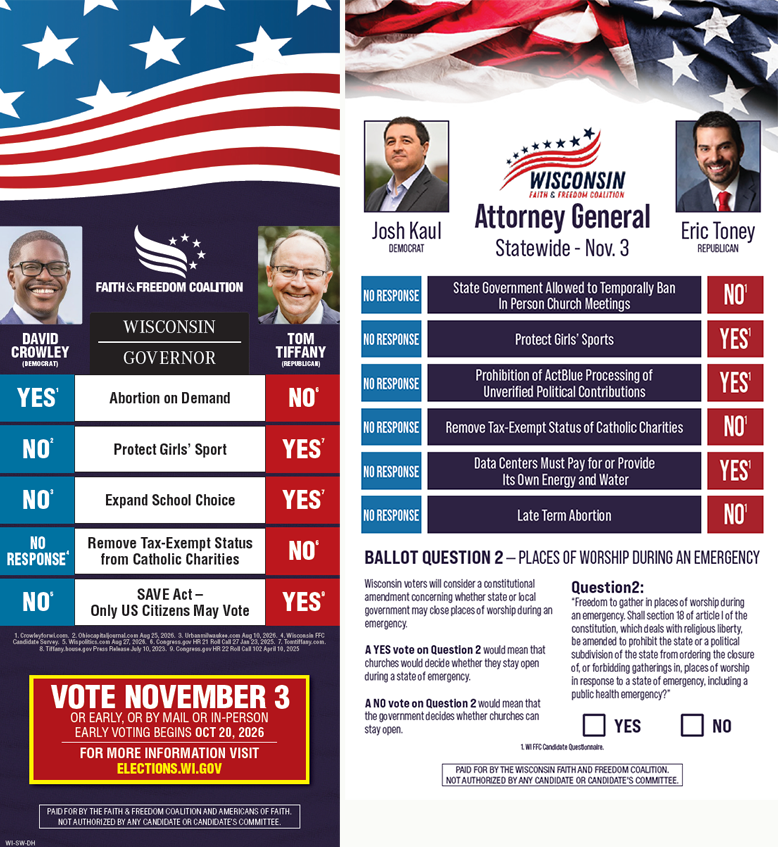
Click here to print the Governor and Attorney General Comparisons Above
What Voters Are Telling Us at WI Doors 29 Days Out
With 29 days until Election Day, Wisconsin looks every bit like the closely divided battleground we have come to expect.
Today, Wisconsin Faith & Freedom Coalition is unveiling our new Races in Your County candidate-comparison page, covering legislative and congressional races across 55 Wisconsin counties, along with statewide comparisons in the races for governor and attorney general. Look up your county, print out the comparisons you want as the links go live, and take them to your church, neighbors, workplaces and other gatherings.
Wisconsin Faith & Freedom Coalition — Races in Your County
We also include information on Question 2, the proposed constitutional amendment on which a YES vote would amend the Wisconsin Constitution to let places of worship decide if they stay open in a case like Covid, and a No vote would let governments shut them down.
From what we are seeing both in the public data and at Wisconsin doors, this election currently looks like two very different contests happening simultaneously:
Conservatives seem to have an edge based of pretty brilliant TV and digital ads – and in a complete reversal of 2022 pro-Tiffany forces have much more money whereas pro-Evers forces had much more money in 2022. At homes we visit where voters tell us both conservative and liberal canvassers have visited before us because their focused “cost-of-living” conservations are more persuasive, and some of the conservative lit we have seen on doors does hit issues that only convince about 15% of those who weren’t planning to vote to make a plan to vote after all.
And either advantage could prove decisive.
The Marquette Poll: Still Just a Slight Edge for Crowley
The latest Marquette Law School Poll, conducted Sept. 16–23 and released Sept. 30, found Democrat David Crowley leading Republican Tom Tiffany 49% to 46% among likely voters, with 5% undecided. Among all registered voters, the race was even closer: Crowley 46%, Tiffany 45%, with 9% undecided. The likely-voter margin of error was ±4.8 percentage points.
The movement since Marquette’s Aug. 12–20 survey is interesting. Tiffany has improved two points among likely voters, while Crowley has improved one point among all voters.
Independents remain substantially less certain to participate, at 61%.
The conservative advantage in the “air war” is partly because of really well-done commercials form Day 1 that bring home key points, and also the complete reversal from the last Governor’s race with the money advantage shifting from the Democrats to the Republicans.
Consider the 2022 race between Democratic Gov. Tony Evers and Republican Tim Michels. The Wisconsin Democracy Campaign ultimately estimated that approximately $87.8 million was spent by Evers and groups supporting the Democratic side, compared with about $75.8 million by Republican candidates and groups on that side across the primary and general election. When you add in that liberals spent 10s of millions of extra money on Soros backed 501c3s while conservatives give very little of their money to 501c3s like Wisconsin Faith and Freedom, the real money last time was likely $110 million helping Evers and $76 million helping Michels.
2026 is different.
According to the latest AdImpact figures, Tiffany has been able to outspend Crowley on campaign advertising by approximately $40 million to $26 million.
Recent campaign-finance reports also showed Tiffany raising roughly $26.3 million during the July-through-September reporting period, compared with roughly $10.2 million for Crowley.
Whatever voters think about the amount of money flowing into politics, the practical political result is clear: conservatives have an unusually large financial and paid-media advantage in this Wisconsin governor’s race.
The question is will that be enough to swing the race from a narrow loss to win for Tiffany despite their huge disadvantage in spending on 501c3 groups (many backed by Soros at least indirectly).
The Ground War: Advantage Liberals
Here the picture looks different.
While WIFFC has knocked only several thousand Wisconsin doors so far this cycle while our teams working with a our related organization have knocked on hundreds of thousands of doors in other states, the Wisconsin conversations are beginning to reveal a recognizable pattern.
Our targets frequently include conservatives who vote in presidential elections but are less reliable in midterms, along with Catholics and other persuadable faith voters.
It is increasingly common to arrive at one of these homes and discover that the voter has already been visited by multiple political canvassers—often more conservative canvassers than liberal ones.
Yet more contacts do not necessarily mean more motivated voters.
A significant number of normally conservative voters tell our canvassers that they have considered sitting this election out. Democratic canvassers appear to be effectively channeling dissatisfaction about groceries, gasoline, health care and the broader cost of living and blaming the side in power – which happens most midterms.
That observation is consistent with Marquette’s statewide data. Its polling has shown inflation and the cost of living among dominant voter concerns, while voters remain gloomy about the economy, groceries and gasoline.
Marquette’s 85%-to-78% Democratic advantage among voters who say they are absolutely certain to vote puts a number behind what we have been sensing at the doors.
Two Issues Win Conservatives Back to the Polls
This is where our experience becomes particularly interesting.
Our canvassers do not open by telling voters which candidate to support. We tell them that Wisconsin Faith & Freedom Coalition wants them to make a plan to vote and that we are leaving information comparing candidates’ stated positions.
That makes the conversations different from a traditional partisan canvass. People who do not feel they are being asked to give the “right” answer are often remarkably candid about whether they intend to vote and what might change their minds.
Two issues on our voter guides are generating especially strong reactions.
Question 2: Who Decides Whether Places of Worship Close?
The first is the constitutional amendment concerning places of worship during emergencies. This vote is simple – YES means a place or worship decides whether in stays open in a case like Covid, and a No vote means the Government decides. It is amazing that half the conservatives who start out telling us they may not vote change their mind once they know that is on the ballot.
In WIFFC’s own turnout modeling, awareness of this issue has the potential to move a substantial number of otherwise low-propensity conservative faith voters from “probably staying home” to “planning to vote.” Our estimate is that the impact could reach roughly 76,000 voters if the response we have measured among regular conservative churchgoers holds statewide, and it moves the same kind of numbers among other center-right voters who are NOT regular church-goers.
Catholic Charities: A Complicated Case With a Simple Reaction at the Door
The second issue producing surprisingly strong reactions—particularly among Catholics—is the Catholic Charities case.
When asked at a door, we are very careful to explain this issue accurately.
The dispute that has already happened was not about stripping Catholic Charities of all tax-exempt status. It concerned whether Catholic Charities Bureau of the Diocese of Superior and four affiliated organizations qualified for Wisconsin’s religious exemption from the state’s unemployment-compensation system.
Wisconsin officials had denied the exemption. The now very liberal Wisconsin Supreme Court upheld that result in 2024, reasoning that the organizations’ activities were not primarily religious because their charitable services were secular in character and they neither proselytized nor limited their services to Catholics – and all nine Supreme Court judges from far left to far right ruled the liberal Wisconsin Supreme Court was WRONG in their attack on Catholic Charities.
The U.S. Supreme Court unanimously reversed that decision on June 5, 2025.
None other than Justice Sonia Sotomayor wrote for the 9–0 Court that Wisconsin’s application of the law violated the First Amendment because government may not distinguish among religions based on theological differences in how they carry out their ministries.
The controversy did not end there.
On remand, Attorney General Josh Kaul’s office argued that the constitutional discrimination could be remedied in either of two ways: extend the existing religious exemption to organizations such as Catholic Charities, or eliminate the exemption altogether. Catholic Charities and religious-liberty advocates strongly objected, and in turn Eric Toney strongly objected.
In December 2025, the Wisconsin Supreme Court finally gave in and ruled that Catholic Charities Bureau and its four sub entities are operated primarily for religious purposes and therefore qualify for the unemployment-insurance exemption.
That distinction matters for our voter guide.
Our questionnaire asks candidates a broader prospective policy question about the tax treatment of Catholic Charities. Republican attorney-general candidate Eric Toney answered No to taking away the exemption; Democratic Attorney General Josh Kaul did not respond.
Therefore, we list Kaul accurately as “No Response” rather than attempting to convert his position in the litigation into an answer to a somewhat different survey question.
But when voters ask why the issue is there, we encourage them to read about the case themselves.
At our doors, it has become one of the strongest issues for moving some Catholic and conservative voters from “I might sit this one out” toward “I am going to vote.”
Why the Assembly May Be the Real Battlefield
All of this leads us to believe Wisconsin’s Assembly contests may be among the most important races to watch over these final 29 days.
A Restructured Wisconsin Team for the Final 29 Days
This final push also comes as we debut our updated Wisconsin Faith & Freedom Coalition leadership and team page.
Executive Director Kelly Herrell has taken an increasingly prominent role in Wisconsin—overseeing field activity while representing WIFFC at events and expanding outreach into communities we believe conservatives cannot afford to ignore.
That includes bilingual outreach. Wisconsin’s Latino electorate is increasingly important, and public reporting after 2024 documented Republican gains among Latino voters even as Democrats continued to win the group statewide.
For these final 29 days, that means keeping Kelly and as much of our Wisconsin organization as possible focused inside Wisconsin while our affiliated Freedom and Family Action national team and LLC handles projects elsewhere.
Our newly updated Wisconsin team includes Kelly Herrell, Executive Director, leading statewide strategy, field and organizational growth; Anna Carter, Treasurer, overseeing finances and compliance; and John Pudner, President, directing strategy and long-term grassroots development.
Wisconsin field leadership also includes Joe Meleski in field operations, Chris O’Brien in church outreach, Natalie Lawrence in phone operations, Chris Lawrence on coalitions and special projects, Randy and Wendy Johnson in the 8th Congressional District, Dr. Virginia Pratt in Southeast Wisconsin, Jacob Immel in the Sheboygan area, and Jack Anderson in- who ran Turning Point and the College Republicans at the University of Wisconsin before a year with Robert Kennedy in the Administration before returning.
