
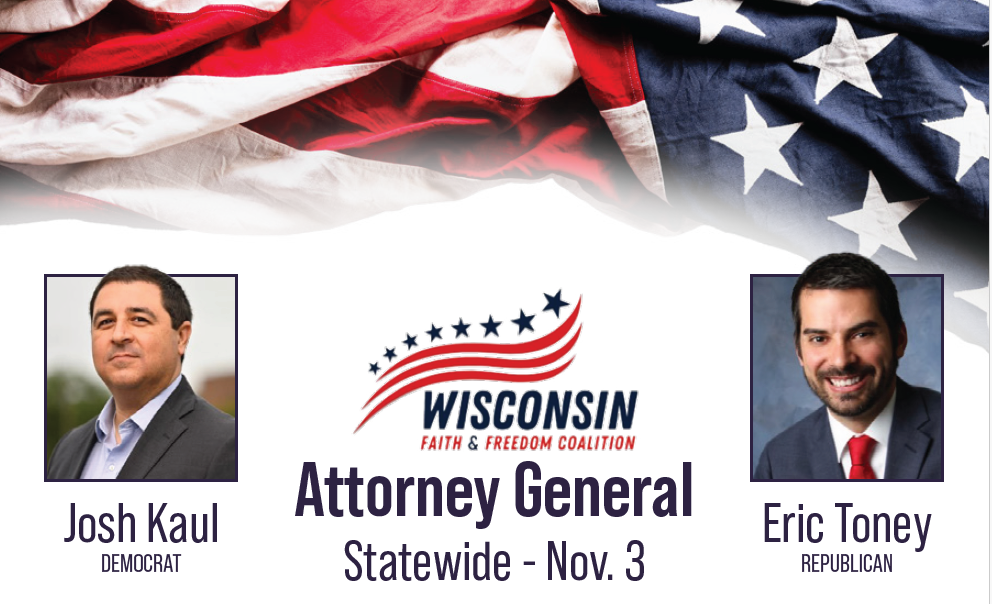
WIFFC Announces Digital Ad Campaign: Kaul vs. Toney
Click to listen to the speech announcing and explaining the new digital ad campaign by WIFFC . You can donate to get more of these voter guides to swing voters by clicking here https://wisconsinffc.com/donate/.
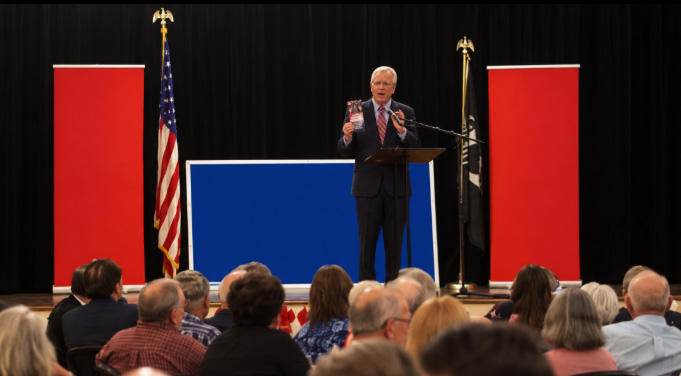
Before a record crowd in Green County, the Wisconsin Faith & Freedom Coalition (WIFFC) Executive Director Kelly Herrell organized the distribution of candidate comparison guides through local churches, while WIFFC President John Pudner announced a new digital advertising campaign to complement the organization’s door-to-door voter education efforts.
Pudner announced that he will team up with longtime friend PJ Wentzel for the third time this year, following two successful political campaigns in which their candidates scored stunning come-from-behind victories.
While the new WIFFC digital campaign will focus on nonpartisan issue education, Pudner’s first two joint digital/canvassing efforts with Weitzel this year were partisan campaigns. First-time candidate Lloyd Peeples stunned the longest-serving member of the Alabama Legislature. In another race, Pudner’s friend and first time candidate John Wahl overcame a large deficit to defeat a statewide candidate and sitting Secretary of State for Lieutenant Governor.
The new digital ads will focus heavily on the Wisconsin Attorney General race between Democratic incumbent Josh Kaul and Republican challenger Eric Toney, particularly their differing positions on the Catholic Charities tax-exemption case.
Kaul defended a position that was ultimately rejected unanimously by the U.S. Supreme Court, including its three liberal justices—Sonia Sotomayor, Elena Kagan and Ketanji Brown Jackson. Toney has opposed removing Catholic Charities’ tax-exempt status.
That issue is also featured in WIFFC’s door-to-door educational materials, along with Wisconsin’s Question 2, which lets voters decide if churches or the government should decide if they shut down in a case like Covid. As Pudner covered in his speech, that ballot question will turn out an estimated 51,000 more conservative church goers if they get a WIFFC comparison piece on the issue, in a state in which most statewide races are decided by less than 35,000 votes.
Ironically the AG race is a rematch of the 2022 race that was decided by exactly 35,000 votes at 1,333,369 for Kaul and 1,298,369 causing many voters to want more educational information on the two candidates. And believe it or not that was only the third closest race that year with US Senator Ron Johnson barely winning re-election by 26,718 votes, and Democratic Secretary of State Doug La Follette surviving by only 7,442 votes.
The following is a lightly edited transcript of Pudner’s introduction, his speech and his closing introduction of four-term Wisconsin Governor Tommy Thompson.
Wisconsin Faith & Freedom Coalition Speech
Green County, Wisconsin — October 10, 2026
Introduction
John Fandrich: Our next guest speaker is someone we’re delighted to have back in Green County: John Pudner, president of the Wisconsin Faith & Freedom Coalition.
He brings more than two decades of experience winning campaigns and building grassroots operations at the highest levels of American politics. He rose to senior vice president of national grassroots at McGuireWoods Consulting, the government affairs arm of one of the nation’s largest law firms.
His résumé includes a 25-year career running Republican campaigns, with an unbelievable record of 185 wins and only 17 losses across campaigns and major policy initiatives, including school choice in multiple states.
He directed nationwide face-to-face turnout efforts for President George W. Bush and helped engineer three separate state legislative takeovers, (beginning in Virginia after graduating from Marquette, when Republicans held fewer than one-third of the legislative seats and no statewide offices. By the time he moved on to Georgia, Republicans controlled all three statewide offices and more than two-thirds of the legislature. After directing Bush’s nationwide turnout effort, he moved on from Georgia, which had become the last state in America to elect a Republican governor after decades of Democratic control. He then moved to Alabama, where Republicans had likewise never controlled either legislative chamber in the modern era. There, he ran the state’s third-largest PAC, the Alabama Farmers Federation (Farm Bureau), and helped launch some of the first massive door-to-door turnout efforts in 2010, when Republicans took control of both legislative chambers.)
After stepping away from campaigning for eight years to focus on policy, he returned to politics in Wisconsin in 2021, serving as political director for Tim Michels for another come-from-behind win to improve his Republican primary record to 14-3.
He also helped build a large-scale voter contact program, including distribution of more than 400,000 voter guides in Wisconsin during the 2024 presidential cycle.
John focuses these days on building the kind of grassroots infrastructure capable of sustaining victories in highly competitive states. And I would say we’re a highly competitive state!
We had the honor of having John at our breakfast meeting in April 2025. He was on his way to speak at the Iowa Republican Convention and asked, “Do you mind if I swing in?”
I said, “Well, John, we usually have about 60 or 70 people at breakfast.”
He said, “No, I’d really like to come.”
So it’s a delight to have him back. Ladies and gentlemen, please welcome the president of the Wisconsin Faith & Freedom Coalition, John Pudner.
John Pudner’s Remarks
Awesome. Twenty-four days out!
I want to be very practical today. I’ve left something on your table, and you can also find it on our website: a candidate comparison piece.
We distributed 400,000 of these pieces in 2024. The first one I’ve handed you today has the attorney general’s race, but I want to explain why I think this is one of the most important formats we can use to get certain voters out.
We’re printing 150,000 of these, which will have the Governor’s comparison on the flip side. We got 400,000 out in 2024, and we’re a 501(c)(3), in case there are any IRS agents in the back of the room I will explain the list!
We can’t coordinate with campaigns. But there are advantages to having a group that doesn’t actually say, “Vote for this candidate,” because these kinds of nonpartisan comparisons have always been allowed in churches and other settings.
We had a little joke during the Trump campaign. If we came up to somebody with one of these pieces and they said, “I hate Donald Trump,” we would, in character, say, “I hate him too!”
Then we’d start pointing to the items on the comparison piece and say, “But this race is about things like fentanyl and gangs coming over the border and whether you want men competing in sports with your daughter.”
Those are just two issues, but the piece never says who to vote for. You draw your own conclusions.
And in certain settings, that can be more effective. I’ll give you some exact examples.
We have a blog on our website, WisconsinFFC.com, with a bunch of these comparisons.
If you go to the blog, you’ll see “Races in Your County.” We’ve set up comparisons for races across Wisconsin.
Again, we can’t talk to the candidates. We just do surveys, we use footnotes, and we look up their records.
For example, I couldn’t go to Senator Marklein and say, “Hey, let’s do some pieces.” But there are things like men competing in women’s sports that he’s voted on, showing a clear distinction between him and his opponent, who didn’t answer the survey.
So if you click on Green County you will see Senator Marklein compared to his opponent Jenna Jacobson, and if you are going to an event just east and click on Rock County you will also see the comparison piece between Congressman Bryan Steil and his opponent Mitchell Berman.
You can take.some of the 150,000 copies we are printing now with the statewide one with the two attorney general and gubernatorial candidates, but you can also print out your local Assembly and State Senate races. We’ve had a couple of places with enough demand for legislative races that we could print 5,000 pieces for a particular race as well.
At the very least, if you’re going to church or you have an event and think, “I wish I had something to hand to the hundred people there,” now you have something.
These kinds of candidate comparisons have always been accepted in churches.
And you heard lieutenant governor candidate David Varnham mention that some of the hardest people to get out to vote in non Presidential years are Christians who don’t regularly vote.
That’s really our focus now.
And I can tell you, every issue on here is kind of a 70-30 issue. We’re not talking about issues that are going to turn a lot of voters off.
So please use these.
We also have digital ads starting up on the attorney general’s race, which we haven’t done in the past.
I’m sure everyone notices that you go through election season and think, “Gosh, I wish there were more information on the attorney general’s race.” There’s just not as much money spent on it.
Our digital campaign will basically take this comparison piece and rotate through the issues. It doesn’t say who to vote for, but I’m going to walk you through a couple of issues that I think will influence whether people vote.
First of all, we put Question 2 on the ballot on this piece for a reason.
In our polling, if you take roughly 100,000 conservative Christians who go to church regularly but don’t think they’re going to vote this year, a lot of the regular issues you bring up get about 15% of them to say they’ll vote.
The actual number is about 96,000, but let’s round it to 100,000.
If you bring up a lot of other things that work with other people, about 15% say, “Okay, I’ll vote,” and about 85% still say they’re not voting.
It’s not a presidential election year.
But when they know Question 2 is on the ballot, in our polling, 51% of them say that will make them vote when they weren’t planning to vote in the first place.
That’s 51,000 out of 100,000, just to keep the numbers round.
(That’s not even counting the impact these had in predominantly black churches as 23% of all black voters in Wisconsin voted for Trump in 2924, more than twice his percentage in the Southern battleground states.)
What is Question 2? It’s very simple.
If we have another case like COVID, who decides whether a church or place of worship stays open?
A yes vote means the church decides. A no vote means the government decides.
This is the simplest issue in the world to explain.
And if you get 51,000 people from that group to come out, versus maybe 15,000 coming out because of another issue, that’s enough votes to decide an election.
So be aware of Question 2. Please bring that issue up.
Sometimes we get into social issues and people worry about scaring voters away. But this year, we actually have two real social issues that are 75% issues. Even voters in the middle are with us on these.
The second issue is slightly more complicated. It’s not as quick to explain, but if you have a little time with someone, it’s worth discussing.
The second issue involves something Josh Kaul tried to do regarding the tax-exempt status of Catholic Charities.
We have a longer explanation on our webpage if you want to read a few paragraphs about the specifics.
But I’m going to do things in reverse order.
I don’t know if you would consider yourself aligned with the three very liberal members of the U.S. Supreme Court: Sotomayor, Kagan, and Ketanji Brown Jackson.
The reason I mention that is the U.S. Supreme Court had to step in and say that what Josh Kaul and the Wisconsin Supreme Court had done regarding Catholic Charities’ tax-exempt status was unconstitutional.
Kaul’s argument was basically that because Catholic Charities also helped non-Catholics it did not really qualify for the religious exemption.
Think about that. Sonia Sotomayor had to write an opinion saying that Kaul and the Wisconsin Supreme Court was wrong.
And this is where we just provide information. I’m not telling you who to vote for.
If you want an attorney general who’s further left than the most liberal members of the U.S. Supreme Court, that’s fine. If not, you probably don’t!
But it’s remarkable.
The first issue, Question 2, is a little easier to explain. But the Catholic Charities issue gets about 30,000 of those 100,000 people who otherwise would stay home to say they’ll vote.
And what’s amazing about that case is that liberals are with us by a few points. You can ask people whether Catholic Charities should lose their tax-exempt status, and even among liberals, we win that issue by a few points.
So it’s an issue that doesn’t cost us anything politically.
That’s why we decided to work on the attorney general’s race this way, as a way to get some of those voters who aren’t motivated by other issues this year.
A lot of people just vote for governor, but there are still voters out there who can be motivated by these issues.
So please, please use this piece and pull it up online.
Again, if you want to read the whole explanation of the Catholic Charities case, it’s on the website. But the basic point is that even the liberal members of the U.S. Supreme Court disagreed with what Wisconsin had done.
You decide what you want in an attorney general.
So that is my spiel.
I just want to keep it simple.
We started doing these side-by-side comparisons back in Bush 2000. Those were partisan, but we didn’t put the candidate names on them. We got 14 million pieces out.
You kids today get to do geofencing. Back then, we had to get 14 million names into a computer to mail things to 14 million people!
So, sorry, this is an old man talking. You kids are spoiled with geofencing!
But I hope you’ll use these pieces. I think they lay the issues out pretty clearly, and you can get them where you want them.
The last thing I’ll say about these pieces is that they’re so fair, and they look so good, that we actually had something funny happen in Georgia.
A big liberal group in that battleground state ran out of its own literature.
They were getting paid to knock doors, and they came into our counterpart, Georgia Faith & Freedom, and said, “We’re out of literature. Your pieces don’t say who to vote for. Can we use them?”
And they literally gave them 10,000 pieces!
So this liberal group took our pieces out to distribute them.
But again, we think that’s a good thing. The next time the IRS calls, we can point to that!
Anyway, I have to take advantage of this opportunity because one of the greatest Wisconsin conservatives in history is speaking after me.
And thank goodness he’s speaking after me!
I was a Southerner who came up to Marquette, and suddenly this guy, Tommy Thompson, was running for governor.
During Governor Thompson’s first race, I wrote my first piece for the Marquette Tribune. I was a punk 18-year-old, asking hos opponent Tony Earl a bunch of tough questions and thinking I was a big shot.
But we were so inspired by his campaign that we took over the Marquette Tribune editorial board and started doing things like endorsing conservative Robert Bork for Supreme Court.
I say that, Governor Thompson, because I’m one of ten thousand people who could tell a story like that.
You have transformed this state. Wisconsin would be a blue state without your tenure, and it is an honor to be speaking in front of you.
Thank you for everything you’ve done.
