
Few Gold, Silver and Bronze GOP States Overcome Blue Wave
With so few successes this month, conservatives should look at the handful of states whose legislative or governor candidates were able to overcome the blue wave.
Only 11 states were able to retain a Republican trifecta and two Republican U.S. senators despite their gubernatorial candidate losing ground compared with the last election—the most impressive being Alabama.
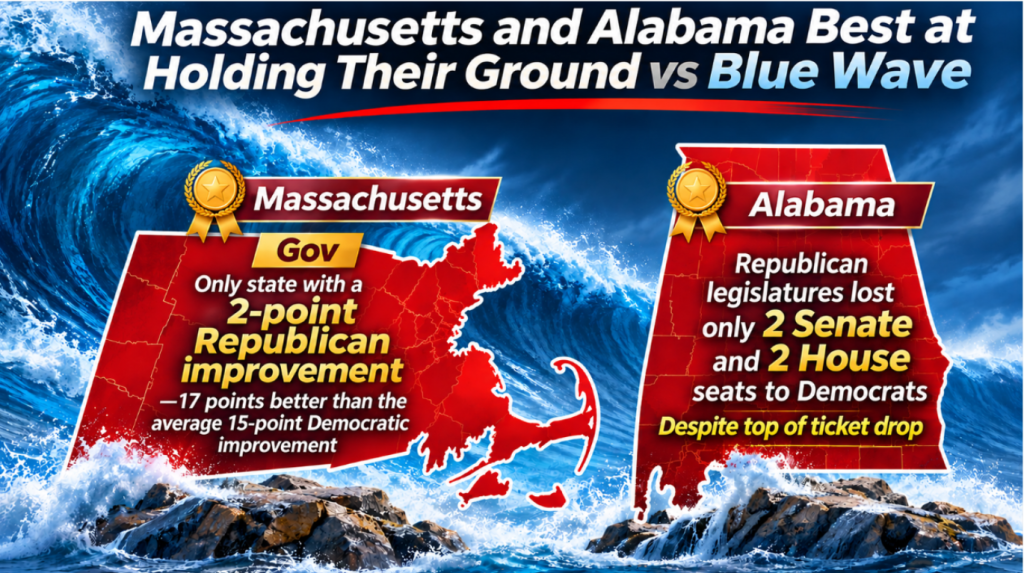
On the governor’s side, the most impressive shift was in Massachusetts—the only state with a two-point Republican improvement, 17 points better than the average 15-point Democratic improvement this election.
Republican Legislative Races: 1 Gold, 2 Silver, 8 Bronze
Gold – 1 State: Alabama
Alabama’s Republican legislators gave up only two Senate and two House seats to Democrats despite the Democratic governor’s candidate improving double digits in the blue wave.
Silver – 2 States: Idaho and Tennessee
Idaho and Tennessee were the only two states that came close to Alabama in overcoming a double digit shift against them at the top of the ticket, each losing only six legislative seats to Democrats.
The other states where Democrats improved by double digits in the governor’s race averaged about a dozen Democratic legislative pickups, except for New Hampshire, where Democrats flipped more than 100 seats.
Bronze – 8 States: AR, FL, KY, LA, OK, SD, WV and WY
Five states—AR, FL, KY, LA and OK—where Democrats gained the more typical 3 to 9 points in the governor’s race (or U.S. Senate race if there was no governor’s race) managed to retain a Republican trifecta and two Republican U.S. senators.
Three other states—SD, WV and WY—accomplished the same feat while holding the Democratic improvement at the top of the ticket to within one point of the previous election.
It’s no coincidence that Alabama was one of the two states where our teams knocked on hundreds of thousands of doors after starting a year before the election. Spending a little money on actual, interactive canvassing over an entire year is much more effective than spending 10 times as much on TV and digital advertising closer to Election Day.
Governor’s Races: 1 Gold, 3 Silver, 5 Bronze
Gold – 1 State: Massachusetts
On a night when the average Democratic improvement in governor’s races was 15 points, there was only one race in which the Republican candidate actually held the Democrat two points below their previous election result—17 points better than this month’s average.
The surprising gold medal goes to Massachusetts, where Democratic Governor Maura Healey dropped two points against Republican Mike Minogue.
As we cover in this blog, the majority of Minogue’s improvement occurred in three of the state’s 14 counties. In two of those counties, our teams knocked on 120,000 doors, while in the third, Massachusetts Family Action ran a very similar program for multiple legislative candidates.
Silver – 3 States: SD, WV and WY
In South Dakota and Wyoming, and in West Virginia using the U.S. Senate race because there was no governor’s race, the Democratic vote share changed by no more than one percentage point. All three states also finished with a Republican trifecta and two Republican U.S. senators.
Bronze – 5 States: KS, ME, MD, MI and RI
In five other states, the Democratic vote share was held to within one point of the previous election, but we rate as bronze because unlike the silver above Republicans did not finish with both a trifecta and two Republican U.S. senators. For the New England states to have two of these states where they held their Governor’s totals, two others where they won the Governors race (NH and VT) and the best improvement of any Governor’s race (Gold Medal Minogue in Massachusetts above) all adds up to New England being the most impressive improvement of any region.
The More Typical Democratic Surge: 27 States
In the majority of states, the Democratic surge was remarkably consistent, with Democrats improving by 3 to 9 percentage points in these 27 states: As noted, the AVERAGE shift was a 15-point Democratic improvement but that was pulled up by the very lopsided races. As noted in previous blogs, our two dozen team leaders originally planned to work in Wisconsin but ended up supervising 124 New England canvassers and 89 in Alabama.
AZ, AR, CA, CO, CT, DE-Sen, FL, GA, HI, IL, KY-Sen, LA-Sen, MN, MS-Sen, NE, NC-Sen, NJ-Sen, NV, NM, NY, OK, OR, PA, SC, TX, VA-Sen and WI.
Methodology: We compared Democratic gubernatorial vote percentages from 2022 to 2026 in the 36 states holding governor’s races this year. In eight other states without a governor’s race but with a U.S. Senate race, we substituted the Senate results for comparison. Changes refer to percentage-point differences for the Democratic candidate in each race.
