Courage of Signers 250 Years Ago Today
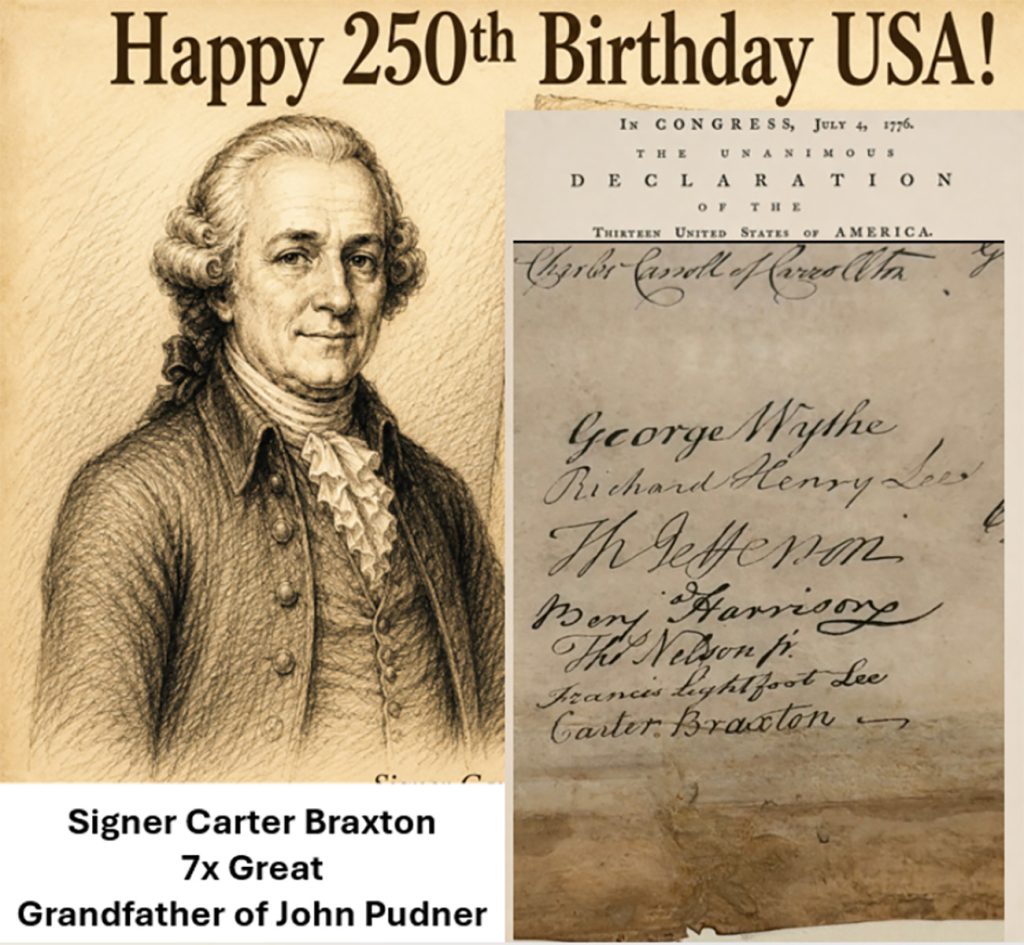
Two hundred fifty years ago today, my seventh great-grandfather, Carter Braxton, joined four other Virginians—Thomas Jefferson, Benjamin Harrison, Thomas Nelson Jr., and Francis Lightfoot Lee—in risking their lives, their families, and their fortunes by signing the Declaration of Independence.
Virginia was tied with New Jersey for the largest delegation of signers, and this Independence Day weekend we celebrate in Massachusetts, home to the most recognizable signer on the document: John Hancock – one of four to sign from Massachusetts along with Samuel Adams, John Adams, and Robert Treat Paine. In all 38 from 12 states signed the document that day, and within a month the number had grown to 56 signers with New York making it unanimous among the 13 states.
While names like Jefferson and Hancock are remembered by nearly every American, many of the other signers have faded from public memory. Yet each accepted the same extraordinary risk. By putting their names on the Declaration, they committed what the British Crown considered an act of treason, knowing it could cost them everything.
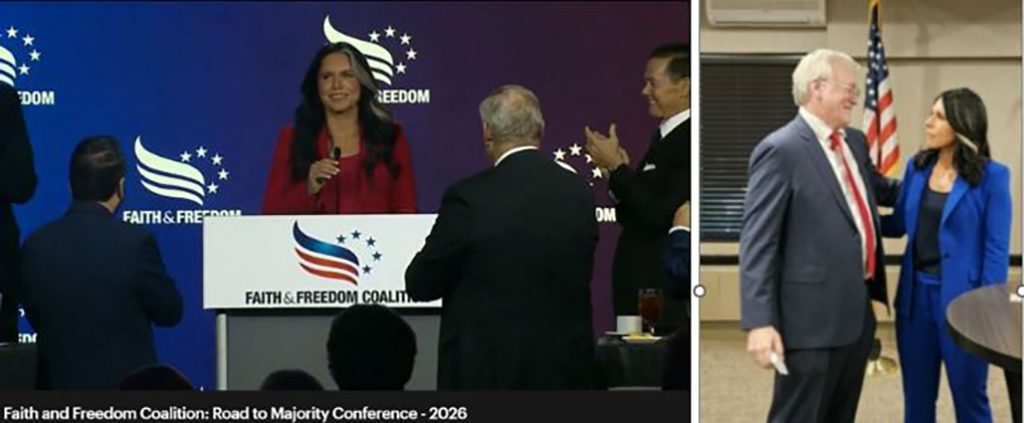
The keynote speaker at this year’s Road to Majority Conference, recent Director of National Intelligence Tulsi Gabbard delivered a moving reminder of those sacrifices. She highlighted the story of one of the lesser-known signers, John Hart of New Jersey, whose life was forever changed because of his decision to sign.
Listening to her remarks also caused me to reflect on Carter Braxton’s role. Unlike some of the more famous Founders, Braxton was not known for dramatic speeches or military exploits. He first sought reconciliation with Great Britain and hoped the growing conflict could be resolved peacefully. Only after those efforts failed did he conclude that independence was necessary and place his name on the Declaration.
The example of my ancestor resonates with me.
I believe good government requires sincere attempts to find common ground whenever possible. But when good-faith efforts at consensus fail, there are principles worth defending. The Founders demonstrated that there are moments when courage requires standing firm, even at great personal cost. At Freedom and Family Action, we first seek to win through legislation—such as when Republicans were joined by Democrats to outlaw the method used by ActBlue to move millions of dollars that ActBlue now acknowledges came from foreign sources into our elections. Thank you to the 31 Democratic members of Congress who cosponsored that legislation, as well as the Alabama and Wisconsin Democrats who crossed party lines to vote yes.
When legislation cannot pass, Freedom and Family Action seeks to defend key values through elections, using the same model we built at WI Faith and Freedom for the 2024 Presidential Election—a right secured 250 years ago by our Founders. Unlike the French Revolution, which claimed hundreds of thousands of civilian lives, or the Spanish Civil War, in which thousands of clergy were killed, the American Revolution was primarily fought between opposing armies rather than through widespread, deliberate attacks on civilians.
No nation is perfect, and it took time for the principle of equality laid out in the Declaration to be fully applied regardless of race, gender, or religion. Most colonies in 1776 still barred Catholics from voting, holding public office, or freely building churches. Yet the day after the signing – on July 5, 1776, – the body decided to add Charles Carroll, a Maryland Catholic, to their body and he would become the Declaration’s only Catholic signer when he joined 18 other delegates in signing the document later that summer—a reminder that the promise of liberty has always been something Americans have worked to expand and more faithfully fulfill.
As America marks its 250th birthday, there is encouraging news. According to a recent Cato Institute survey, 86% of Americans say they are grateful to be American, and 70% believe the nation’s founding principles remain important. At the same time, nearly half of Americans do not realize this anniversary commemorates the signing of the Declaration of Independence—a reminder that our history is worth preserving and retelling.
I was honored to be on stage as Tulsi Gabbard reminded thousands gathered in our nation’s capital of what those signers sacrificed. Her story of John Hart beautifully illustrates the cost of freedom and why the Declaration remains as relevant today as it was in 1776.
Below are excerpts from her remarks. I would encourage everyone to watch the entire speech.
https://nation.foxnews.com/watch/43504b72cb109fc75b042ff827a13727/
Let’s go back to what the signers of the Declaration of Independence faced 250 years ago. I’ll start with one of them—John Hart, a 65-year-old farmer from New Jersey with a wife he dearly loved and 13 children. (We then laughed as Tulsi added, “He REALLY loved his wife.”)
John Hart wasn’t famous. He wasn’t seeking glory or headlines. But in the summer of 1776, he signed the Declaration of Independence knowing, as every signer did, that he was committing what Britain considered an act of treason—an act that could cost him the life that he knew and everything he owned.
In Hart’s case, it did. Soon after he signed, Hessian soldiers hired by the British ransacked his farm, destroyed his fields and mill, and forced him into hiding. At 65 years old, he slept on the ground in the forests and caves of New Jersey while his beloved wife lay dying at home.
He never made it back in time to see her before she died. By the time he returned, she had been buried, and his 13 children had scattered into hiding for their own safety. He never saw them again and died a few years later, alone.
I share his story because it reminds us of the sacrifices that secured our freedom. The question the signers faced was not rhetorical, and it cannot be rhetorical for us today. Each of us should ask how the talents and abilities God has given us can be used to defend our Constitution and preserve the freedoms that generations before us sacrificed so much to protect.
As we celebrate Independence Day, it is worth remembering the truth our Founders declared: that we are all created equal and endowed by our Creator with certain unalienable rights. Those rights come from God—not from a king, a government, a politician, or any institution—and therefore no government has the authority to take them away.